 |
|
|
|
reason -at- fightaging -dot- org
|
|
Recent Entries
Redesigned and Spreading Out in Middle Age
Thinking About Cryonics
Dreams of Molecular Nanotechnology
Help Build the Science of Aging Timeline
The Most Popular of Popular Media
Trending in the Right Direction
Ending Aging Translated into Russian
The First Rejuvenation Research Issue of 2009
Russian Media Coverage of Aubrey de Grey and SENS
A Few Cryonics Posts
Evaluating the Life Lost to Fat
Aubrey de Grey's BIL Presentation
The Chattering Classes on the Longevity Dividend
The Open Access Journal AGING
Ouroboros at ETech
An Interesting Perspective on Neurodegeneration
The Present Bottom Line on Calorie Restriction
More Scientist Bloggers Sought By Ouroboros
Replacing a Damaged Stem Cell Population
Telomeres and Autoimmune Disease
Archives (Monthly)
March 2010
February 2010
January 2010
December 2009
November 2009
October 2009
September 2009
August 2009
July 2009
June 2009
May 2009
April 2009
March 2009
February 2009
January 2009
December 2008
November 2008
October 2008
September 2008
August 2008
July 2008
June 2008
May 2008
April 2008
March 2008
February 2008
January 2008
December 2007
November 2007
October 2007
September 2007
August 2007
July 2007
June 2007
May 2007
April 2007
March 2007
February 2007
January 2007
December 2006
November 2006
October 2006
September 2006
August 2006
July 2006
June 2006
May 2006
April 2006
March 2006
February 2006
January 2006
December 2005
November 2005
October 2005
September 2005
August 2005
July 2005
June 2005
May 2005
April 2005
March 2005
February 2005
January 2005
December 2004
November 2004
October 2004
September 2004
August 2004
July 2004
June 2004
May 2004
April 2004
March 2004
February 2004
January 2004
Creative Commons
Fight Aging! is published under the Creative Commons Attribution 3.0 license. In short, this means that you are encouraged to republish and rewrite Fight Aging! content in any way you see fit, the only requirements being that you (a) link to the original, (b) attribute the author, and (c) attribute Fight Aging!.
|
 |
|
|
|
As you might have noticed, I've implemented a minor redesign here at Fight Aging! and over at the Longevity Meme in the past couple of days. It's a sort of spreading out in middle age: as the average size of monitors grows, an layout designed for 800x600 pixel screens begins to look cramped and low-rent. Now we're on a layout that has 1024x768 in mind, and, by the magic of adding a lot of empty space, the same old material suddenly looks much more up to date and sophisticated. Funny the way that works.
A couple of other odds and ends were tided up as I notice them, and I hope to achieve more of the same in the next few days. The search function here at Fight Aging! now uses Google rather than the increasingly hopeless in-built Movable Type search, for example, and is as a result much more useful. I've moved it up in the left navigation to a position that reflects its newly acquired utility.
So while my attention is focused on these and similar housekeeping matters, it's a good time for you, the audience, to point out things that might need updating or are otherwise not up to scratch. I'm hoping that nothing was outright broken by the update, but it's always possible I missed an item stuck away in the corners, or that appearances are suffering in one of the less common browsers. Let me know if that's the case.
|
|
|
|
|
I think it goes without saying that all minority interests suffer from credibility gaps. We humans are hardwired to be skeptical when we look in on something said to be good but not indulged by many people. It's a defense mechanism, most likely, but it does mean that when you do have a genuinely good, new idea, you'll know by the way you have to work hard to get anyone to listen.
Cryonics, the low temperature preservation of the fine cellular structure of the body and brain at the end of life, is a good idea. There's a non-zero chance you'll be repaired and revived in a future of wondrous technologies, with the chance to live on for a very long time in a fascinating era. That compares favorably with the other options open to the dying, but cryonics remains a fringe practice. It hasn't yet bootstrapped to the level of participation that prevents knee-jerk rejection from most people.
In this vein, a couple of recent posts from the community I'd like to draw to your attention:
A Few Cool Quandaries
I've recently found out just how "weird" and even "crackpottish" the idea of cryonics seems to Most People. I actually always saw it as one of the less weird things a person might conceivably find intriguing. But apparently that isn't the case.
The Daily Mail Tackles Cryonics
The Daily Mail, a UK tabloid legendary on the Internet for its dense celebrity reporting, has finally taken on the coolest topic of all - cryonics. Like many articles about freezing yourself solid to be revived in the future, this one is negative.
Or is it? The Mail is a media outlet renowned for its disdain for facts in an industry renowned for its disdain for facts, but here, possibly accidentally, it turned out an article that might actually give a net positive impression.
|
|
|
|
|
There's no law of physics that will prevent we clever humans - and our enhanced descendants - from eventually building technologies that can maintain and arrange every aspect of our bodies exactly as we'd like them to be. Technologies that can find every out of place molecule or damaged component and promptly fix it up. Aging will be a thing of the past in that era of molecular nanotechnology, whenever it comes to pass.
Systems that can identify, manage and place trillions of molecules accurately are not a pipe dream; after all, we are already surrounded by examples. You, for example, are just such a system, albeit somewhat slow at self-assembly to full size. There's nothing in the laws of physics that jumps out and says we can't do this. It's just a matter of time.
If you have the technology base to build a nanoforge to assemble a brick, then you also have the technology base capable of simultaneously assembling and controlling a hundred million medical nanorobots of arbitrary design and programming. Or an artifical lung better than the real thing, or replacements for immune cells that never get old or worn. You get the idea. A brick is just as complex as any portion of the human body if you have to build the thing molecule by molecule; more fault-tolerant, but just as complex.
Our cells are already very impressive examples of adaptive machinery. The machines our descendants will build with the knowledge gained from today's study of biology will be even more impressive yet. Cells, for all their intricacy, are far less efficient and organized than the laws of physics permit. One day, that inefficiency and disorganization will be eliminated by machinery intended to augment or replace our cells, and everyone will be the better for it.
If's good to look ahead up the ladder every now and again to remind yourself why you climb it. The future is golden, if we can sort out the issues on these bottom rungs to ensure we make it there. I notice that a presentation by Christine Peterson of the Foresight Institute transcribed at Future Current touches on some of what may come:
Another consequence of this in the long-term, and I think this will be true in your lifetime, is what would happen if we have atomic-scale control of our bodies. In the mid-term timeframe I was talking about nailing cancer. No more cancer cells, so that people do not die of cancer anymore. With this level of technology, you move on. What’s left? What kind of disease could a human being have that could not be addressed with this level of technology eventually? It’s hard to say.
I suppose a massive accident - you’re hit by a truck. That could be the end. But in terms of disease, where there is time, it’s not clear what kind of disease you could have that would not be treatable with this level of technology. Basically, you want to put the atoms of your body back in a healthy arrangement.
What about aging? Aging, as we know, is a very complex process. There are many things that are all going on at one time, but all of them are misarrangements of atoms. In principle, if you could figure out what a healthy pattern of atoms and molecules in the body is, you could then restore that pattern. The goal, of course, is that you not disrupt the structure of the brain, because that is where your memories and your personality are. I don’t mind if everything from [the neck] down is rebuilt - start from scratch, make it all perfect. But up here [the brain] we need to keep the patterns.
Ultimately, I think aging is addressable. When that happens is very hard to say.
|
|
|
|
|
Via Ouroboros, we learn of an interesting community project:
Paul House has started a project that should be of wide interest to Ouroboros readers: a Timeline of Discoveries in the Science of Aging. His goal is to facilitate the creation of a record of the major events in the history of (bio-)gerontology, and publish it in a visual interactive form that grows in response to user input. Clicking on an individual event along the timeline expands it into a full article.
...
The idea is for the site to be interactive in multiple ways - not only in the sense that the timeline is a clickable object that expands in response to user behavior, but also in the sense that user-generated content can be incorporated into the object itself. It’s like a visual wiki.
So if you can think of a major event in the history of our field that belongs on the chart, visit the Science of Aging timeline and make an entry.
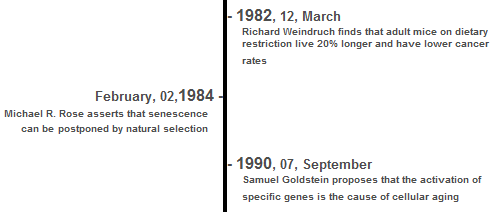
It looks much like this once it's going:
This has a lot of potential to develop into a helpful educational tool for advocates, I think. A visual timeline is a very intuitive way to show people that there is momentum in the field, and that work is being accomplished. For better or worse, people are much more likely to get behind and help push a wheel that is already rolling - and so the easier it is to show that aging research is rolling along and producing results, the easier it will be to attract more supporters.
|
|
|
|
|
A theory on popular media: the more popular it is, the less the information it provides bears any semblance to accuracy, truth, or scientific fact. As the audience size grows - meaning that any given topic is going to be far outside the specialty knowledge of nearly all of the audience members - any urge to accuracy is completely subsumed by the need for do and say things that will keep that audience's fleeting attention. I think this principle is fairly well illustrated by Oprah and company's present examination of calorie restriction and some related topics in medical research in the context of enhanced human longevity.
There's a style to this sort of thing, in which the presenters construct a framework for their article or show that ostensibly bears some semblance to the underlying reality under discussion, but within which a majority of the "facts" provided are simply wrong, chosen for their ability to grasp attention rather than any scientific backing they may have.
Hence for a discussion of longevity, wild and unsupported claims are fair game. At the present time, the scientific consensus is that human practice of calorie restriction will not greatly enhance maximum longevity, but does greatly improve health and greatly reduce risk of age-related disease. That isn't as exciting, however, as earlier speculation on attaining 120 year or more life spans, so the more exciting "fact" is what gets aired:
Dr. Oz says calorie restriction is the number one way doctors say we can extend longevity. "The data that we have in rodents and some larger animals now indicate you can probably extend your life expectancy by up to 50 percent potentially from doing this," he says.
Freedom of speech bears just as much of an implied caveat emptor for the listener as any other freedom. Expect people to lie to you (by omission, laziness, or more direct motives) when it serves their own self-interest more than telling you the truth - which is the case for almost all popular media serving large audiences.
|
|
|
|
|
Presently available medical technology is always crude when compared with what's presently taking shape in the laboratory. Take cancer therapies, for example: unpleasant and painful chemotherapy remains the state of the art in the field, but laboratories are turning out targeted therapies with next to no side-effects, or using the immune system to eliminate cancer.
This vast gap between lab and clinic is made particularly pronounced by the heavy burden of regulation that ensures commercial development of new therapies is expensive and slow, where it takes place at all. Yet even with this ball and chain, and even lacking the impressive technology still in trials, trends in results of therapy are still moving in the right direction. This is aptly illustrated by this data on cancer survival:
New data and analyses from a long-running study of cancer survival in Europe have shown that the number of people actually cured of cancer - rather than just surviving for at least five years after diagnosis - is rising steadily.
A special issue of the European Journal of Cancer [1] containing reports from the EUROCARE-4 Working Group, includes, for the first time, an estimate of the proportions of patients who are cured of their cancer in Europe and who, therefore, have a life expectancy equal to that of the rest of the population. The analysis divides patients into two groups - the proportion who may be considered cured of their disease and who are likely to die of something else, and those who will die of their cancer.
The study compared two periods - 1988-1990 and 1997-1999 - and found the proportion of patients estimated to be cured of lung, stomach and colorectal cancers increased from 6% to 8%, from 15% to 18% and from 42% to 49%, respectively.
...
"Geographic variation in the estimated proportion of patients diagnosed in 1988-1999 who were cured ranged from about 4% to 10% for lung cancer, from 9% to 27% for stomach cancer, from 25% to 49% for colon and rectum cancer, and from 55% to 73% for breast cancer."
There's a long way to go in terms of defeating cancer if you just project out that trend - but the work presently taking place in the laboratory goes far beyond trend continuation. The next generation of cancer therapies are completely new approaches and technologies that can be expected to greatly increase survival rates where they are deployed. This makes it all the more frustrating that we are saddled with a regulatory prison that prevents and discourages new medicine.
Regulatory bodies like the FDA have every incentive to stop the release of new medicine: the government employees involved suffer far more from bad press for an approved medical technology than they do from the largely unexamined consequences of heavy regulation. These consequences go far beyond the obvious and announced disapproval of specific medical technologies: the far greater cost lies in all the research, innovation and development that was never undertaken because regulatory burdens ensure there would be no profit for the developer. Personal gain for the regulator is thus to destroy the gains of people they will never meet, the exact opposite of what occurs in an open marketplace.
|
|
|
|
|
A short Russian language blog entry provides we decadent Westerners with a picture of the cover of the translated version of Aubrey de Grey and Michael Rae's "Ending Aging".
Congratulations to those involved in the translation process: translation of a scientific work is never easy, especially when its focus is on research that is still cutting edge. Much of the crucial terminology in new fields is essentially made up from whole cloth or built of unusual compound words that draw on language roots and traditions of nomenclature that English and Russian may not have in common. In addition, precision of translation is important, as positions of understanding are built up over many succeeding steps - an incorrectly translated early stage can render whole pages of information nonsense.
Ending Aging is a dense, informative, and valuable book, as well as a call to action for an age in which we could, collectively, be doing far more to reverse the damage of aging than is presently taking place. The more people who have the chance to read Ending Aging, the better.
|
|
|
|
|
I'm sure you've all already noticed that Rejuvenation Research Vol 12 Number 1 is available online. I'm late as usual in pointing it out, but better late than never. I should draw your attention to one of the papers, "Unexpected Regeneration in Middle-Aged Mice", as the full PDF version is presently free for access in one of the journal publisher's occasional promotions.
Complete regeneration of damaged extremities, including both the epithelium and the underlying tissues, is thought to occur mainly in embryos, fetuses, and juvenile mammals, but only very rarely in adult mammals. Surprisingly, we found that common strains of mice are able to regenerate all of the tissues necessary to completely fill experimentally punched ear holes, but only if punched at middle age.
Although young postweaning mice regrew the epithelium without typical pre-scar granulation tissue, they showed only minimal regeneration of connective tissues. In contrast, mice punched at 5-11 months of age showed true amphibian-like blastema formation and regrowth of cartilage, fat, and dermis, with blood vessels, sebaceous glands, hair follicles, and, in black mice, melanocytes.
These data suggest that at least partial appendage regeneration may be more common in adult mammals than previously thought and call into question the common view that regenerative ability is lost with age. The data suggest that the age at which various inbred mouse strains become capable of epimorphic regeneration may be correlated with adult body weight.
Now this is interesting indeed. You'll recall the MRL mice that show unexpected regenerative powers, something that has been known for a few years now. What these researchers have shown is that several other species of lab-bred mice have similar unexpected regenerative capabilities. This leads me to expect that, in the years ahead, scientists will uncover a complex and interrelated network of controlling genes and biochemical processes that can be manipulated at several points to produce exceptional healing in mammals. That discovery process will look much like the ongoing work attending metabolic changes in calorie restriction - a lot of potential controlling genes, much confusion and contradiction in the early years, and progress to initial therapies on a timescale of 10 to 15 years.
|
|
|
|
|
The Science for Life Extension foundation did a good job of marshalling up the Russian language media for Aubrey de Grey's recent trip to Moscow - I pointed out a good Russian media interview at the time. By way of their labors, and either Google or Yahoo!'s machine translation services (both of which produce fairly horrible results), a selection is provided herein. There's surprisingly little hype and mangling of the message beyond that produced by the translator automation.
The brave may want to dive right ahead into the audio and multimedia offerings:
And here are a range of print articles:
Aging: How to undo the verdict?
But what constitutes aging? The first group are those that occur in the body, starting from young age. The second are those that occur at the end of life. Defects and damage in the body accumulate and lead, eventually, to aging and death. To combat these processes now used two approaches. First - Geriatric, which offers a variety of means to hinder the processes that lead to aging. Second - Gerontology, examines why and how in the normal metabolism defects arise and how you can affect the metabolism. De Gray believes that both approaches are bad, and even the researchers involved in their study, does not believe that aging can be overcome in the near future.
The secret of eternal youth
Scientific lectures now rarely collect complete halls. But here both theme and persona of lecturer - everything straight-away cast a spell. Speech by British guest at the House of scientists gathered this full house.
In Moscow went scholar
Aubrey believes that the scientific and medical development [will be] improved faster than the accumulated damage in the body. This is the principle of [longevity escape velocity] escape from old age. As will become available first generation therapy, people get even more healthy 20-30 years old. During this time science and medicine will find new ways of strengthening and extension of health.
Scientist Aubrey de Grey
In fact, Aubrey is standing in the world scientific community. A doctoral thesis devoted to biology of aging. Defend it in Cambridge - one of the pillars of world science. And it does not promise instantaneous rejuvenation, asserting: fight with the old age - complex and long process. To be famous and created a Methuselah Foundation, which - funding for research to extend human life. Last year the fund has spent 2 million dollars worldwide. Now Aubry first came to Moscow - to seek allies.
Cellular technologies will bring to humanity a thousand years younger
Renowned gerontologist Aubrey de Gray is convinced that using cellular technology in the near future, life expectancy can be increased [by] 30 years
The first man, who live to 150 years, now may have 60
"I believe we can defeat aging in the near future. There is 50-percent chance that the man who was the first to live to 150 years old, is already live, and he is now 60 years old" - said De Gray on Saturday at a meeting with journalists in Moscow, organized by fund "Dynasty" and "Science for the extension of life."
Extravagant [Biogerontologist] Proposes the Methods of Retaining the Eternal Youth
Aubrey De Gray (Aubrey de Grey) - the world-famous British [biogerontologist] working in Cambridge, the chief editor of Rejuvenation Research, the only peer-reviewed academic journal devoted to effects on the aging process. His main research interests - the study of cellular and molecular damage in human aging, as well as the development of methods for the rejuvenation of the body based on the removal of lesions.
British gerontologist considers that life can be extended up to 1000 years
De Gray noted that most scientists agree that aging is not associated with [a] genetic program of self-destruction, supposedly rooted in the body, [but rather with] the accumulation of defects, damage, which then leads to disease and death.
Eternal youth is available in 30 years
"How do you feel about the participation of Russian research groups and organizations in your project?" - Asked Director Gray. "I have a lot of Russian colleagues in the UK and the U.S. - said the scientist. - We have not yet been funded gerontological research in Russia. But I see Russian scientists enormous scientific potential".
Death can be a bum beer
What such is old age? This is a breakdown in the organism as a result of the wear of some of its components. It means in order to avoid old age, it is necessary in time to change or to clean 'spare part'.
This week, staff met with the British [biogerontologist] Aubrey de Gray
Mr. de Gray, you are often accused of that, you're trying to "play God", doing research, which - extend [life]. How do you [respond to] these accusations?
- Deeply convinced that the reluctance to extend the life will be terrible crime against the "higher forces". After all, aging brings pain, suffering and infirmity, it kills people. All the major religions say that we are obliged to keep suffering to a minimum. If God wants us to live up to exactly 100 years old, he will find a way to realize their vision. The Holy Scripture does not indicate that we must not ease the [sufferings of] age.
Eternal youth is available in 30 years
"In the next 25-30 years will develop the first treatment, which would extend the healthy human life for 30 years", - promises to de Gray. However, a single treatment of old age will not be able to lead to a complete rejuvenation of the body. Soon, he again begins to accumulate damage, and possibly treat it will be increasingly difficult.
But these difficulties, according to de Gray, can be solved: "Progress in science is, and therapy will gradually improve".
The man who lives 1000 years has already been born
To prolong fleeting youth, to postpone inexorable old age, to conquer the diseases, which poison last year of the life of any person, these dreams disturb the imagination of people not of one hundred years. But the fantasy of scientists never stretched further 100-150 years of cheerful and healthy life.
Then came Aubrey De Gray and changed the course of ideas of people about the possibilities of science. Yes who is he, the agitator of scientific calmness?
I have omitted a bunch of others that are reprints in various different media outlets, but you get the idea. Engineered longevity through the application of science is an idea that the Russian media is receptive to, it seems.
|
|
|
|
|
I've been meaning to point out a few posts on cryonics from elsewhere in the community, but it keeps slipping my mind. So here they are while I remember, starting with some areas ripe for improvement in the current practice of cryonics identified over at Depressed Metabolism:
Evidence Based Cryonics
There is an urgent need [for cryonics providers such as Alcor] to move from extrapolation based cryonics to evidence based cryonics. This will require a comprehensive research program aimed at creating realistic cryonics research models. It will also require vast improvements in the monitoring and evaluation of cryonics cases. The current debate should no longer be between advocates and opponents of standby and stabilization but about what stabilization procedures should be used by cryonics organizations given our current knowledge.
Microvasculature perfusion failure in cryonics
Under ideal circumstances cryonics patients are stabilized immediately after pronouncement of legal death by restoring blood flow to the brain, lowering temperature, and administering medications. In most cryonics cases, however, there is a delay between pronouncement of legal death and start of cryonics procedures. In some cases there are no stabilization interventions at all. Provided that these periods of warm and cold ischemia are not too long, such patients can still be perfused with a vitrification agent. But how thorough cryoprotectant perfusion (and thus vitrification) in these cases can be remains an unresolved issue.
The cryonics industry is still small, which means that despite the sterling efforts of those involved on the research and development side, little work has been done in the grand scheme of things, in comparison to the technology involved in any larger industry. Cryonics is still a good sight better than the alternative, but we shouldn't overlook the spacious room for improvement.
On that note, I see that Robin Hanson is offering to debate anyone for an hour on the topic of cryonics, and provides another of his examinations as to just how rational it is to be signed up for cryosuspension:
More precisely, if folks are reasonably smart about when to try to revive you, your total revival chance is something like a sum across all future times of such calculations, each one given no destructive failed prior attempt.
If you make 50K$/yr now, and value life-years at twice your income, and discount future years at 2% from the moment you are revived for a long life, but only discount that future life based on the chance it will happen, times a factor of 1/2 because you only half identify with this future creature, then the present value of a 5% chance of revival is $125,000, which is about the most expensive cryonics price now.
So cryonics might be an economically sound choice - based on the way in which people tend to value predictions about the future, and under Hanson's model - even when that prediction is for a low chance of success. This has similarities to the structure of Pascal's Wager, though I'm sure someone will be by to tell me why that's an inaccurate comparison.
|
|
|
|
|
A topic I revisit here and at the Longevity Meme with depressing frequency is the damage done to health and longevity through holding on to excess body fat. There's a lot of denial on this topic, but it's hardly rocket science: the weight of scientific evidence clearly shows that extra fat increases the risk of all sorts of age-related conditions that will cut years from your life. Not to mention the years in which you're made more miserable than you would have otherwise been due to suffering those conditions.
Not all of the mechanisms by which fat tissue hurts us are fully understood, but enhanced levels of chronic inflammation seems to be one of them. Correlation with lack of exercise is no doubt another, given the large difference regular exercise can make to your healthy longevity over the years. We already know that rising levels of chronic inflammation are important in shaping the deterioration of the aging body, and it looks like extra fat tissue creates that issue earlier and in greater force than would otherwise be the case.
I noticed a popular press article today on one of the recent studies that links fat to a shorter, less healthy life:
The studies used Body Mass Index (BMI), a measurement that divides a person's weight in kilograms by their height squared in meters to determine obesity. Researchers found that death rates were lowest in people who had a BMI of 23 to 24, on the high side of the normal range. Health officials generally define overweight people as those with a BMI from 25 to 29, and obese people as those with a BMI above 30.
...
Peto and colleagues found that people who were moderately fat, with a BMI from 30 to 35, lost about three years of life. People who were morbidly fat - those with a BMI above 40 - lost about 10 years off their expected lifespan, similar to the effect of lifelong smoking.
Moderately obese people were 50 percent more likely to die prematurely than normal-weight people ... obese people were also two thirds more likely to die of a heart attack or stroke, and up to four times more likely to die of diabetes, kidney or liver problems. They were one sixth more likely to die of cancer.
This is in the same ballpark as other studies and reviews I've seen in past years. If you want a better chance of living longer, don't get fat - it's pretty much common sense.
|
|
|
|
|
Over at Future Current, you'll find a transcript of Aubrey de Grey's presentation at the BIL unconference. He goes into detail as to some of the research presently supported by the Methuselah Foundation, that funding made possible by generous donations from the pro-longevity community over the past few years. Such as:
A fantastic, originally Serbian immunologist called Janko Nikolich-Zubich, who is a prominent gerontologist and works in Tucson at the University of Arizona, has become very interested in the possibility of being more ambitious about repairing and rejuvenating the immune system than anyone has previously been. There are two major things that go wrong with the immune system during aging and they fall into two of seven categories that I always talk about. People have been exploring these things in isolation in a somewhat halfhearted sort of way for quite some time, but no one has had the balls to do them together.
I have managed to persuade Janko to do this. He is basically applying a combination therapy to mice whose immune systems are going downhill because of aging and seeing whether the immune systems can be really rejuvenated so that the mice are better at resisting infection, getting back to where they were in early adulthood. It is a reasonably long project, as is more or less any project involving the aging of mice, but it is already underway. It is being funded by the Methuselah Foundation and we are extremely happy about it.
If you look at Nikolich-Zubich's research brief, you'll see:
Diagnosis of the most critical, primary defects in innate and adaptive immunity of the old age is being followed by studies to repair or modulate those defects by immune intervention as well as by tailored, rational vaccine design.
...
The main virus targets of these studies are herpesviruses (HSV and CMV) and flaviviruses (chiefly the West Nile virus - WNV).
...
Another fascinating problem is the interaction of the immune system with life-long chronic and persisting pathogens from the herpesvirus family, and the impact of this interaction upon the aging immune system. These studies should pave way for the immune reconstitution and vaccine engineering experiments that will ameliorate and treat the undesirable consequences of immune senescence.
Cytomegalovirus (CMV) is the most interesting item here, because it seems to be a major culprit in degrading the immune system with age. While it doesn't cause much immediate harm, over time its presence causes more and more of the immune system's resources to be (uselessly) dedicated to fighting it, leaving little left for more critical tasks. You can look back in the Fight Aging! archives for more on that - there's a healthy body of investigative research publications on cytomegalovirus and its effects on the immune system over time.
|
|
|
|
|
Here are a couple of recent posts on the prospects for longevity engineering from the political blogger set, so focused firmly on what it means for policy - as for everything that gets discussed in that sphere. Very dreary after the first five minutes or so, but what do you expect? The more interesting artifacts are, I think, the comments to the second post, and that's where we see what that sort of circle really thinks about longevity research and the future.
The Longevity Dividend
The original justification for retirement was that by the time people reached a certain age, they were worn out and used up and deserved a few years of dignified leisure in their decline. But that idea is already changing as lives extend, and medical developments on the horizon suggest that it might change a lot more. Could we save our troubled pension systems by developing ways to keep people healthy, and working, much longer
...
But even much more modest progress--extending healthy middle age from 60 to, say, 80 - would permit significant shifts in retirement ages and allow for a longevity dividend that could go a long way toward preventing the looming pension meltdown.
Work Longer, Be Happier?
It wouldn’t be politically easy, of course, to shift grant money away from diseases toward more basic research to slow aging. Nor would it would be easy to raise the retirement age. But Mr. Reynolds argues that that most people - i.e., most voters - would be willing to work longer in exchange for better health. “Seems like there’s an opportunity here for a politician who’s willing to get ahead of the curve,” he says. What do you think? Would you take that bargain? And what kind of research would best benefit from this sort of shift?
I seem to recall bemoaning the culture of entitlement that underlies so much of public discourse. Where on earth does one get the idea that life and health without hard work is possible? It should go without saying that if you're alive and in good health, then you're going to be working one way or another - there's no such thing as a free lunch, and that roof over your head doesn't pay for itself. Enjoying your work and making the best of life is up to you, and in theory you should be getting pretty good at that task after a few decades of practice.
|
|
|
|
|
By way of Ouroboros we learn of a new open access journal on aging science, titled AGING. I'm always pleased to see the spread of open access science in the areas I'm interested in: it heralds faster research as barriers to the spread and analysis of knowledge are lowered.
AGING publishes high-impact research papers of general interest and biological significance in all fields of aging research including but not limited to cellular senescence, DNA damage and repair, organismal aging, age-related diseases, genetic control of aging from yeast to mammals, regulation of longevity, evolution of aging, anti-aging strategies and drug development and especially the role of signal transduction pathways in aging and potential approaches to modulate these signaling pathways to extend lifespan.
In the first issue, there are a couple of items of interest, amongst them a review paper on chromatin modifications and aging. This is a topic that has cropped up before, and is an aspect of epigenetics in aging:
Strictly speaking, 'epigenetics' refers to chromatin and DNA modifications that are heritable through cell division, but do not involve changes in the underlying DNA sequence ... Chromatin structure is not fixed. Instead, chromatin is dynamic and is subject to extensive developmental and age-associated remodeling. In some cases, this remodeling appears to counter the aging and age-associated diseases, such as cancer, and extend organismal lifespan. However, stochastic non-deterministic changes in chromatin structure might, over time, also contribute to the break down of nuclear, cell and tissue function, and consequently aging and age-associated diseases.
It's all still somewhat up in the air as to what is causing what with respect to chromatin changes, and this biochemistry is very complex. But take a look at the paper and see what you think.
Chromatin Modifications: The driving force of Senescence and Aging?
It has been well recognized that, as the mammalian cell ages, its chromatin structure evolves, both at a global level and at specific loci. While these observations are mostly correlative, recent technical developments allowing loss-of-function experiments and genome-wide approaches have permitted the identification of a causal relationship between specific changes in chromatin structure and the aging phenotype. Here we review the evidence pointing to the modulation of chromatin structure as a potential driving force of cellular aging in mammals.
...
if chromatin modifiers can directly contribute to the aging phenotype, what is the molecular circuitry leading to the modulation of their activities during the aging process, and may it be altered as a therapeutic means?
|
|
|
|
|
Chris Patil of Ouroboros was at ETech to give a presentation:
To describe, in an accessible manner, recent progress and ongoing current work in understanding the basic biology of aging, including research currently being performed in his own lab group as well as subjects of interest in the broader field of biogerontology. From there, he will proceed to several ambitious, collaborative, interdisciplinary ventures currently getting underway. These include a new project, recently initiated by himself and others, that will compare dozens of animal species and ask questions about how natural selection has "tuned" longevity over the course of evolution - with the ultimate goal of achieving a greater understanding of the mechanisms limiting human longevity.
To defend the idea of intervening in the process of human aging, from the standpoint of quality of life, individual rights, and overall benefit to society. In the process, he will answer some of the major objections to extending human longevity, and also discuss the real social challenges resulting from various possible life extension technologies.
Though apparently it's not a great crowd for life science research and biotechnology. In one of his blog posts on ETech, he muses on the concept of "segmental longevity therapies", which I find intriguing:
I’m using the term in the sense of “segmental” progerias, conditions in which an organism expresses some but not all component of accelerated aging. What if the first longevity therapies are much better at dealing with one aspect of the aging process than others? For example, imagine a therapy that kept brains completely intact (no Alzheimer's) but was lousy at maintaining the musculature - or even more problematically, vice versa. Obviously we’re not going to design therapies to ignore specific systems, but on the other hand, we’re not in tight control over what sorts of technologies are going to emerge (or come into wide use) first. The first longevity therapies may well be segmental, whether or not they 'ought' to be. What are the ramifications of that?
This doesn't seem unlikely on the face of it. For example, consider the outcome if the first meaningful therapy out of the gate is the repair of mitochondrial damage, and nothing else gets off the ground for a decade following that. Repairing mitochondria seems plausibly likely to help everything except cancer. Equally, if effective repair of age-damaged immune systems is first to market, that helps suppress cancer and the consequences of sensencent cells, amongst all the other jobs of the immune system, but doesn't do much for things like muscle loss, cardiovascular disease, Alzheimer's, and so forth.
The ramifications that spring to mind are that (a) these therapies will be reduced in effectiveness of extending life by other limiting conditions, (b) we'll want researchers to work in parallel on all the modes of age-related damage such that those limits are all pushed out at the same time.
|
|
|
|
|
This open access paper outlines an interesting perspective on the origins of the many common forms of age-related neurodegeneration, such as Alzheimer's disease:
The present article examines several lines of converging evidence suggesting that the slow and insidious brain changes that accumulate over the lifespan, resulting in both natural cognitive aging and Alzheimer's disease (AD), represent a metabolism reduction program. A number of such adaptive programs are known to accompany aging and are thought to have decreased energy requirements for ancestral hunter-gatherers in their 30s, 40s and 50s. Foraging ability in modern hunter-gatherers declines rapidly, more than a decade before the average terminal age of 55 years. Given this, the human brain would have been a tremendous metabolic liability that must have been advantageously tempered by the early cellular and molecular changes of AD which begin to accumulate in all humans during early adulthood. Before the recent lengthening of life span, individuals in the ancestral environment died well before this metabolism reduction program resulted in clinical AD, thus there was never any selective pressure to keep adaptive changes from progressing to a maladaptive extent.
I can't say I'm completely sold on the high level conclusion, which seems to depend on relatively unsupported assumptions about the dominant selective pressures acting during specific decades of primitive hunter-gatherer life. Some thought-provoking points are made along the way, however, so I encourage you to read the whole thing.
All humans begin to develop the neurological markers of AD during their early 20s and continue to do so throughout life, most towards clinically irrelevant degrees. But why would these markers present in everyone? How could natural selection have allowed them to become so invasive and ubiquitous if they did not hold some sort of evolutionary significance?
|
|
|
|
|
I noticed a recent review paper that does a good job of summing up the present consensus on the practice of calorie restriction - eating fewer calories while still obtaining all the necessary micronutrients - in humans:
There are currently no interventions or gene manipulations that can prevent, stop or reverse the aging process. However, there are a number of interventions that can slow down aging and prolong maximal lifespan up to 60% in experimental animals. Long-term calorie restriction without malnutrition and reduced function mutations in the insulin/IGF-1 signaling pathway are the most robust interventions known to increase maximal lifespan and healthspan in rodents.
Although it is currently not known if long-term calorie restriction with adequate nutrition extends maximal lifespan in humans, we do know that long-term calorie restriction without malnutrition results in some of the same metabolic and hormonal adaptations related to longevity in calorie restriction rodents. Moreover, calorie restriction with adequate nutrition protects against obesity, type 2 diabetes, hypertension and atherosclerosis, which are leading causes of morbidity, disability and mortality.
...
More studies are needed to elucidate the molecular mechanisms underlying the beneficial effects of calorie restriction in humans and to characterize new markers of aging/longevity that can assist clinicians in predicting mortality and morbidity of the general population.
It should be clear by now that even absent significant longevity benefits in humans, there are many very good reasons to be practicing calorie restriction - such as a much better chance to avoid the common conditions that cut people short in later life. Every additional year of healthy life you can engineer for yourself is an extra year you can wait for longevity science to advance to produce methods of repair for the damage of aging. At the present pace of basic research, enabled by biotechnology that continues to improve at a breakneck rate, a few years is a significant length of time.
|
|
|
|
|
The eminently respectable group blog Ouroboros, focused on the biology of aging and related aging research, is looking for more scientist bloggers to swell their ranks:
Do you want to write for Ouroboros? The three main criteria are as follows:
- Be a working scientist in a field relevant to the biology of aging.
- Have strong English writing skills, and a perfectionist streak about your prose.
- Be willing and able to commit to writing a ~500-word post based on a recent journal article about the biology of aging, around once every two weeks.
Writers tend to converge on subjects that interest them, so it would be nice if you had a sense of what sort of pieces you’d like to cover. Our current contributors are working on calorie restriction, transcriptomics and systems biology, telomeres, and mitochondria - but that leaves a lot of ground un-covered.
Writing about science for an open audience is an excellent opportunity for young researchers in this field to broaden their pool of connections and hone their writing skills while at it. If you know of anyone who might fit the criteria and be interested, send them over.
|
|
|
|
|
You might recall that a combination of chemotherapy and introduction of new immune system stem cells has been used to successfully "reboot" a damaged immune system in a number of different early trials, thereby curing an autoimmune disease. Judging from this research I noticed today, the strategy seems to work for damaged muscle stem cell populations as well:
An experimental procedure that dramatically strengthens stem cells' ability to regenerate damaged tissue could offer new hope to sufferers of muscle-wasting diseases such as myopathy and muscular dystrophy, according to researchers from the University of New South Wales (UNSW). The world-first procedure has been successfully used to regrow muscles in a mouse model, but it could be applied to all tissue-based illnesses in humans such as in the liver, pancreas or brain, the researchers say.
The research team, which is based at UNSW and formerly from Sydney's Westmead Children's Hospital, adapted a technique currently being trialled in bone marrow transplantation. Adult stem cells are given a gene that makes them resistant to chemotherapy, which is used to clean out damaged cells and allow the new stem cells to take hold.
...
"The beauty of this technique is that chemotherapy makes space for stem cells coming into muscle and also gives the stem cells an advantage over the locals. It's the first strategy that gives the good guys the edge in the battle to cure sick tissues,"
...
"In muscle, most stem cells die in the first hour or are present in such low numbers that they are not much help," Professor Gunning said. "Until now, the new healthy cells had no advantage over the existing damaged tissue and were getting out-competed.
Destroy the old and replace with the new: this approach to regeneration is in its infancy, but it holds a great deal of promise for dealing with the damage of aging in stem cell populations. All development is focused on specific diseases at the moment - a situation forced upon us by regulatory bodies who deny approval for therapies for aging - but the technology platforms produced can then be applied to age-related damage in a more enlightened time or place.
The chemotherapy is the ugly part of the equation for the moment, a deeply unpleasant procedure that no right-minded person would ever undertake without good cause. Fortunately, the development of methods for killing specific cell populations with few or no side effects is also advancing rapidly. One can evisage a future not so many decades away in which our stem cell populations are routinely destroyed and replaced every thirty years or so to eliminate accumulated damage that reduces their effectiveness.
|
|
|
|
|
An interesting correlation to add to the others involving telomerase:
In rheumatoid arthritis, T cells are chronically over-stimulated, invading the tissue of the joints and causing painful inflammation. This derangement can be seen as a result of the loss of the immune system's ability to discriminate friend from foe
...
"What we see in rheumatoid arthritis is an aged and more restricted T cell repertoire," she says. "This biases the immune system toward autoimmunity."
...
They found the answer in telomerase, the enzyme that renews telomeres and is necessary to prevent loss of genetic information after repeated cell division.
...
T cells are some of the very few cells in adults that can turn on telomerase when stimulated, probably because they have to divide many times and stay alive for decades. Weyand and Fujii found that T cells from patients with rheumatoid arthritis make 40 percent less telomerase enzyme when stimulated.
The researchers suggest that restoring telomerase to T cells could possibly help reset the immune system and halt rheumatoid arthritis, but I think that remains as a conjecture to be proven. Is there a slippery slope of declining telomerase for some people, ending up with immune systems that fall into disfunction at earlier ages? Or does some other aspect of this particular autoimmune disease cause the drop in telomerase production? Identifying the cart and the horse here isn't straightforward.
Telomerase is tied in to more than just telomeres: it seems to influence mitochondrial function as well. Variations in telomerase activity and telomere length are clearly associated with aging and specific age-related conditions, but it's far from clear how it all links together, and all of the interesting new research results I'm aware of from the past couple of years have served to complicate the picture.
|
|
|
|
|
In a complex, evolved system like our cells, everything connects to everything else. Evolution is adept at generating systems with a lot of reuse, feedback loops, and the same component performing multiple simultaneous jobs. It does make it very challenging for researchers to determine what is going on in our metabolism, however. Isolating a gene and the protein it produces because it is important to a cellular process you are interested in barely gets your foot into the door - then must follow years of tracing relationships to other genes, proteins, mechanisms, and so forth.
Over recent years it has become clear that the gene SIRT1 is important to the health and longevity benefits of calorie restriction. It has also become clear that SIRT1 is very well connected inside the cell, being involved in any number of aspects of our metabolism. So while, for example, one group has good evidence that SIRT1 works by promoting repair processes involving heat shock proteins, we also see that is important to the regulation of autophagy, another process well-linked with health and longevity benefits.
SIRT1: Regulation of longevity via autophagy
Recent studies have emphasized the importance of SIRT1, a mammalian homolog of Sir2 longevity factor, in the regulation of metabolism, cellular survival, and organismal lifespan. The signaling network interacting with SIRT1 continues to expand as does the number of functions known to be regulated by SIRT1.
Autophagy is also an emerging field in longevity studies. [Autophagy] is a housekeeping mechanism cleaning cells from aberrant and dysfunctional molecules and organelles. The extension of lifespan has been linked to the efficient maintenance of autophagic degradation, a process which declines during aging. Interestingly, recent observations have demonstrated that SIRT1 regulates the formation of autophagic vacuoles, either directly or indirectly through a downstream signaling network.
...
The interactions of SIRT1 [can] also regulate both the autophagic degradation and lifespan extension emphasizing the key role of autophagy in the regulation of lifespan.
Interesting, altering SIRT1 on its own, such as through the use of calorie restriction mimetic drugs, doesn't appear to gain anywhere near the entire benefit of calorie restriction. So other mechanisms are at work in addition to those uncovered through exploring SIRT1's connections.
|
|
|
|
|
It is not uncommon to see people suggest that efforts to extend healthy life should not take place while there is great suffering and poverty in the world. These is something deeply hardwired into the way our brains work that leads to an instinctive rejection of disparity in wealth - or at least a rejection of that guy over there having more wealth. As this bioethicist puts it:
When I talk to people about my interests in [engineering greater healthy longevity through science] are a number of reservations and concerns they have. Let me briefly identify, and address, two of them: (1) many feel that talk of retarding human aging sounds like mere science fiction; and (2) many express the viewpoint that it is distasteful to worry about decelerating aging when there is so much poverty and disease in the world.
But the instinct that leads to rejecting longevity engineering is a patchy one that leads us falsely. You don't see many of these people giving up their comfortable lifestyle because it is better than poverty. You also don't see many of them decrying the progress of the past century that has led to better medicine - all accomplished while there was much poverty and disease in the world. They accept the beneficial progress that has taken place while at the same time recoiling from more beneficial progress accomplished under the same circumstances.
This is an issue rather than a depressing curiousity because widespread support is needed if engineered longevity is to make progress at a rapid pace. That same bioethicist believes this is a matter for persuasion and education:
One might wonder why, given all the pressing issues facing women in the world today, that they ought to add aging and longevity science to the list of things to address. "Is it really a priority?" one might ask. "Is it a priority in a world with disease and poverty?"
This is a fair question. And the answer is "YES!". Why? Because most disease in the world today is caused by aging. Now you won't find data from the World Health Organization that states that explicitly. But what you will find are the data concerning the proximate (rather that evolutionary) causes of morbidity and mortality. But behind the proximate causes of most human deaths (like cancer and heart disease) are the biological processes of aging. In other words, it is not a coincidence that most people who suffer disease and death today are over age 60. The vulnerabilities of late life reflect the tradeoff that natural selection has made between the fitness of a parent and reproduction. Natural selection favors a strategy in which organisms invest fewer resources in the maintenance of somatic cells and tissues that are necessary for indefinite survival of the individual (source).
The enormous and unprecedented disease burden the world will experience this century makes vivid the human toll of this tradeoff. Take the year 2005, the latest year that one can easily find the stats from the World Health Organization. Approximately 55 million people died in 2005. Of that number, 35 million died of chronic disease. That number is twice the number of deaths due to infectious diseases (including HIV/AIDS, tuberculosis and malaria), maternal and perinatal conditions, and nutritional deficiencies. That is a staggering figure. Furthermore, between the years 2005-2015 WHO estimates that 220 million people will die from chronic disease, most of them (144 million deaths) in lower middle income countries like China and India. The diseases associated with aging are not, contrary to popular perception, only a problem for people living in the developed world. Indeed, being vulnerable to disability and frailty is a much greater disadvantage if one lives in a poor society with no decent health care or pension, as the link between income and "ability to work" is much more direct. So the chronic diseases associated with aging are a problem for all societies, not only the richest countries in the world.
Which is nicely done, presenting facts to change minds without attempting the much harder task of addressing the underlying prejudice against unequal progress. I'd prefer to live in a world in which it was realistically possible to bring entire populations to a greater understanding of economics, such that only a few people instinctively seek to block progress in the name of equality, but I don't believe that this is such a world.
|
|
|
 |